Glimpse into Made to Last Forever: Buccaneer Captain Cromwell, Susan Fairbanks, Fifth Fairbanks Child, and Secret Revolutionary War Expedition
Glimpse into Made to Last Forever: Privateer: Captain Thomas Cromwell
An intriguing story in Made to Last Forever begins with the voyage of the Fairbanks family escaping from the turmoil of England in early 1600 to their resettlement in the newly forming Massachusetts Bay Colony. The family consisted of Jonathan Fairbanks, his wife, Grace, and their six children ranging from three-years-old to teenagers.
We don’t have any information about the voyage of the Fairbanks family. About 50% of the ship manifests from that time were lost or deteriorated. Much research was done on other documented voyages through the journals of the Mayflower in 1620, Rev. Francis Higginson’s account of the earliest voyage in the development of the Massachusetts Bay Colony in 1629, Rev. Richard Mather’s Journal of the ship named James that sailed into Boston during the hurricane in 1635, and Joselyn Johnson’s Account of Two Voyages to New England.
As we will examine the life of Susan in this blog, it should be noted that her illness at birth and on the Fairbanks’s voyage is not found in historical fact.
There are only about three characters in this book that are not actual people of their place and time in history. One of the three was the young shipmate, Thomas, that Jonas befriended during the voyage from England to New England. Thomas was used to create conflict between Jonas and his father later in the book and to introduce an actual character of New England in the 1600s, Captain Thomas Cromwell. The whole story can be found in Made to Last Forever: A Family. A House. A Nation.
Captain Thomas Cromwell (1617-1649) in this book should not be confused with Thomas Cromwell, the Chief Minister to King Henry VIII. Captain Thomas Cromwell in Made to Last Forever was an actual privateer or buccaneer written about by Governor John Winthrop of the Massachusetts Bay Colony and Governor Bradford of the Plymouth Colony.
The privateer or buccaneer Cromwell was commissioned by the Earl of Warwick to loot Spanish ships for their silver and other valuables. Cromwell brought the wealth into Boston on three different occasions. On one of his hauls to Boston, he brought back a very expensive “sedan” or shoulder carried chair for Governor Winthrop.
On another, landing at Plymouth and Boston, Cromwell’s crew was jailed for excessive drinking and cavorting. In Boston, Cromwell himself was arraigned in the colony’s court for killing one of his own crewmen. This intriguing true story unfolds in the book. Even though Captain Cromwell collected some wealth himself, he continued to stay in the hovels of Boston instead of other refined establishments even when he had the means to live better.
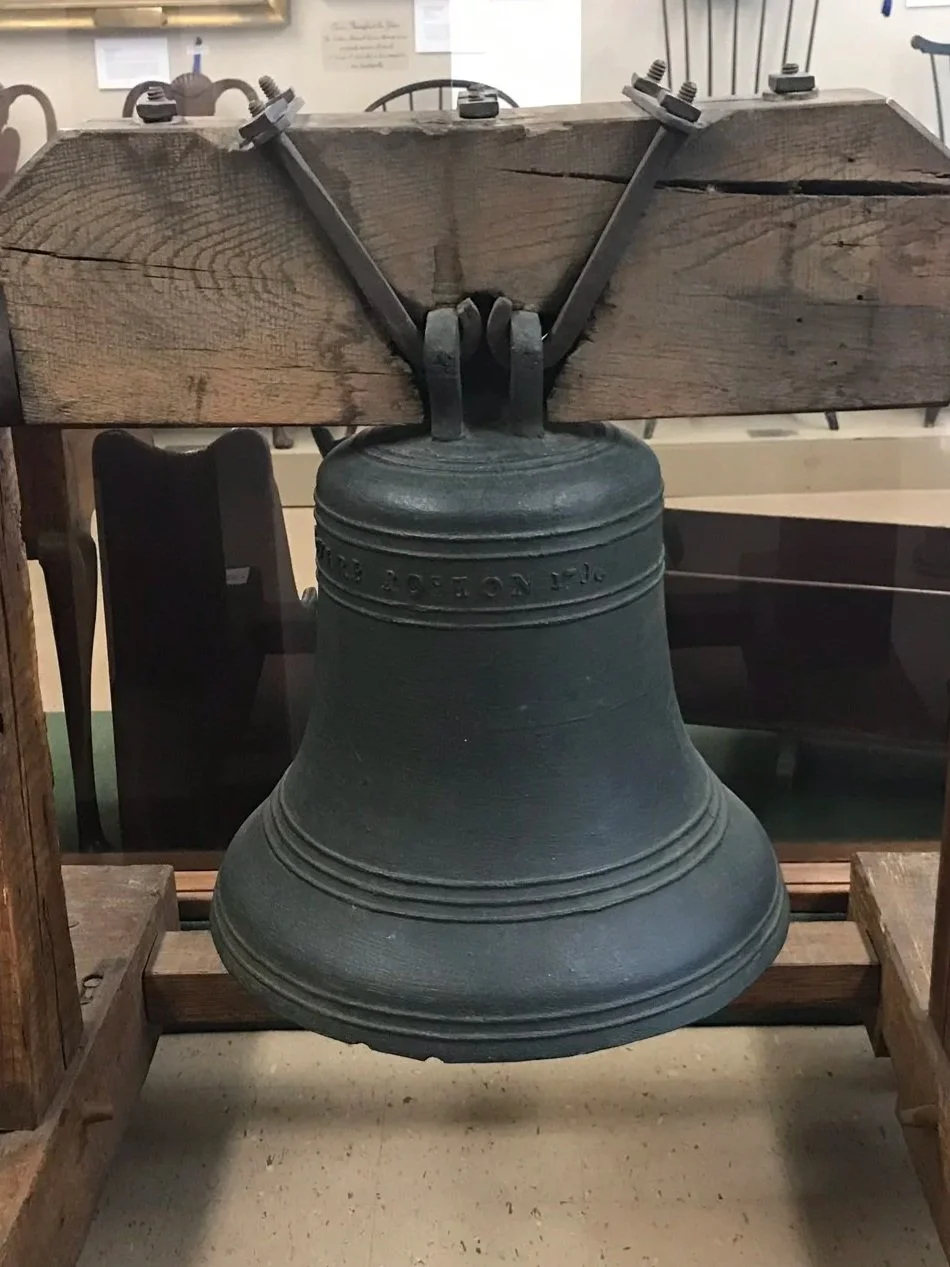
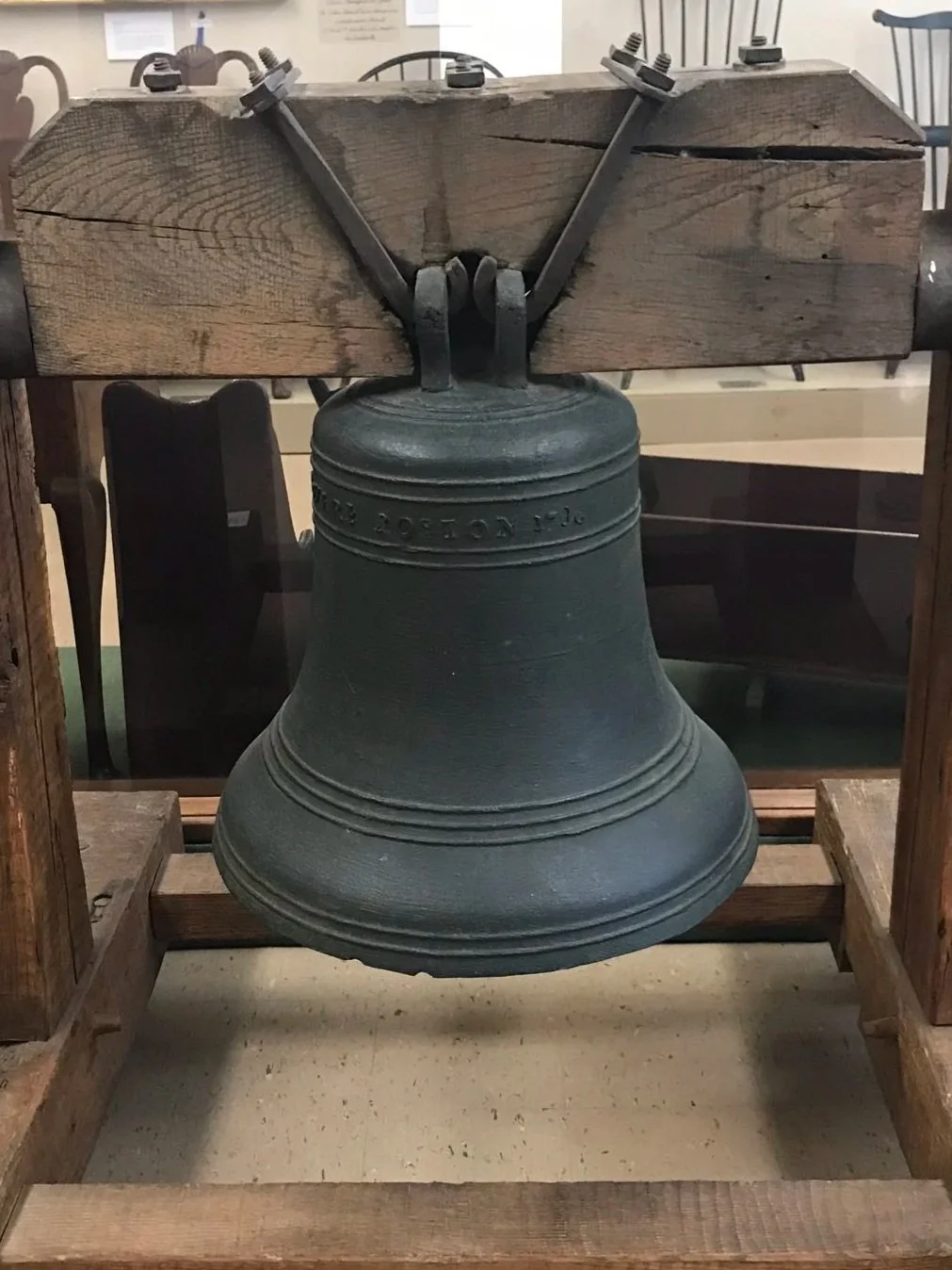
Bell similar to the one hung in the Dedham Church in 1652.
The last time Cromwell docked at Boston, his career ended. He died of a fall onto a lethal object. This was quite ironic as the crew member he killed was injured by a similar object.
On this last trip to Boston, he delivered six large bells from his expedition, the kind used in churches or other buildings. One of these bells was purchased by Dedham for their church in 1652.
There is no relationship known between Captain Thomas Cromwell and Jonas. However, the infestation Jonas encountered during this scene was a true phenomenon in that general area at that time in history. It was written about by Edward Johnson in Wonder Working of Providence.
Enjoy this scene in Made to Last Forever: A Family. A House. A Nation.
Susan Fairbanks (c.1627-1659)
Fifth Child of Jonathan and Grace Fairbanks
Susan Fairbanks was the fifth child and second daughter of Jonathan and Grace Fairbanks. Unlike their older children, Susan was not found in the records of St. John the Baptist Church in Halifax, West Yorkshire, England. A partial, badly damaged entry in the records of the St. Mary The Virgin Church in Thornton-in-Craven is found with the date December 1627, approximate birth date of Susan. This date would mean Susan was born about two years after Jonas, Jonathan and Grace’s fourth child, who was christened at St. John the Baptist Church on March 6, 1625. Approximately two years was typical between births for that era. The information about the St. Mary The Virgin Church document was provided by Bob Abel, Chairman of Earby and District Local Society.
There is nothing conclusive about the St. Mary The Virgin entry except it indicates a female child of a J. Fairbanke. Jonathan’s father, John, lived in Thornton-in-Craven area and was buried at the St. Mary The Virgin Church on August 7, 1625, during the initial year of the plague. This was two years before the birth was documented. The father’s oldest son, John (b 1586), by the father’s first marriage, had a son, John, and a grandson who lived in that area. No daughters were mentioned. The father’s other son, George, had no children. A third son, Joseph, died in 1593. It appears likely that the J. “Fairbanke” could have been Jonathan, the immigrant, and his daughter, Susan, who has a suitable date for birth at that time.
Susan died in Dedham in 1659 at approximately 32 years of age before her parents or her other siblings. This was the impetus to make Susan a weak baby at birth and very ill on the voyage. There is no indication of her having any illness or weakness in history.
The two most common causes of death for females in this era were fire and childbirth. Fire deaths were frequently from the long skirts they wore while they worked over open fires in the hearths. It appears by the date of birth of Susan’s last child and her death that she probably died in childbirth. Susan’s last child was a son, Ralph Day who was baptized February 11, 1657. Susan died July 8, 1659, which was just over two years from her last delivery.
Like most women of that time, we have little information about their lives. Susan married Ralph Daye a proprietor in Dedham on October 12, 1647. Ralph Daye was 2 -7 years older than Susan. It appears that he was from Halifax Parish in Yorkshire, England. He was admitted into Dedham as a proprietor in 1644. He became a freeman in 1645, a title given to those who were full citizens of the colony. He could vote, hold office and serve on juries.
Susan and Ralph had five children. They lost their first child two days after birth. Three of the remaining four children lived to marry. The other died at age 17.
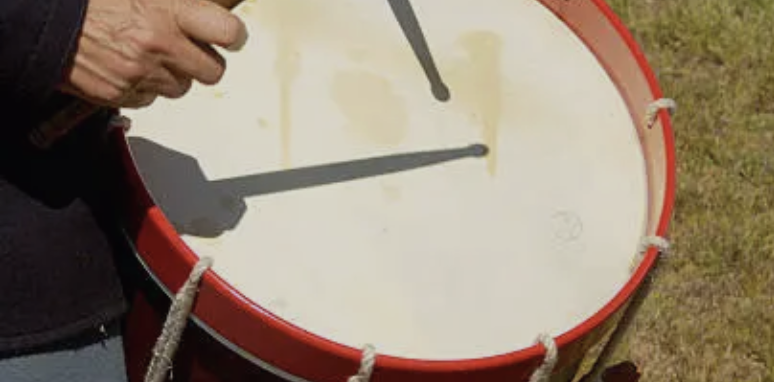
Ralph Daye was a drummer for Dedham’s communications before they purchased a church bell in 1652.
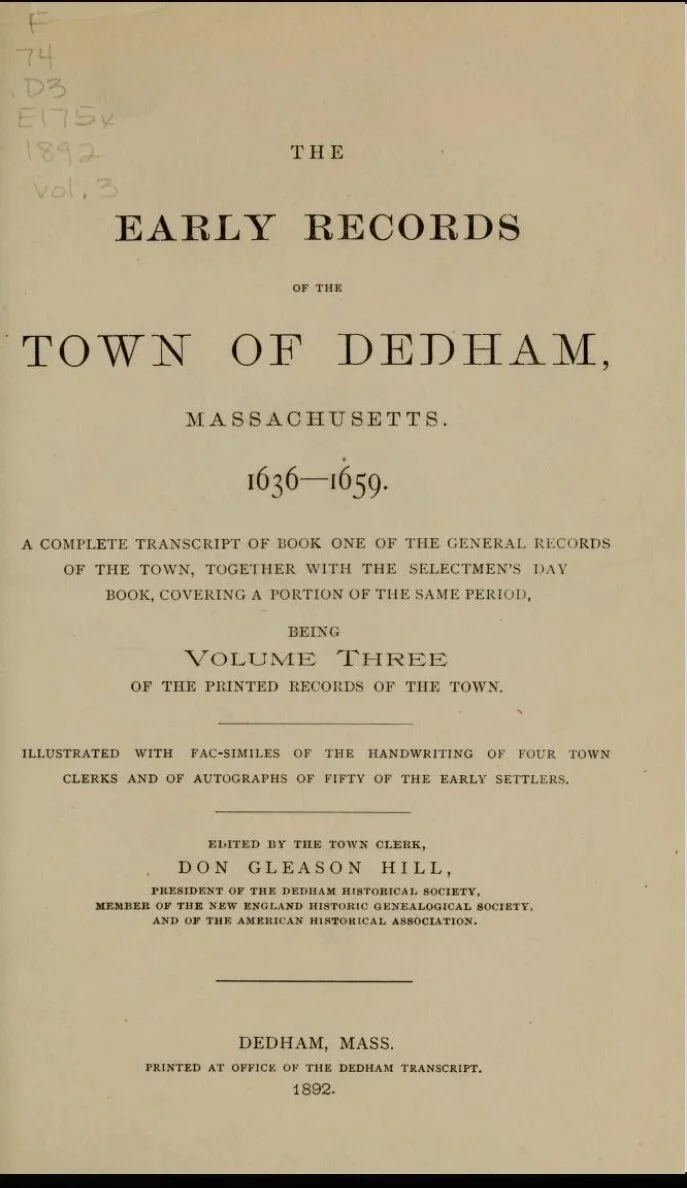
To get a brief idea of Susan’s life, the Dedham Town Records were reviewed for Ralph Daye’s records. Ralph must have started beating the drum for Dedham’s communications early, because in 1646, he was being paid in cedar boards for his service (DTR Vol. 3, p. 113)
Ralph was given liberty to use clay from the town’s land to make bricks. He was also given trees from the town land to fence in the clay pits for safety. Ralph was known as a mason and had masonry tools on his inventory at death. He received grants along with other proprietors in the common cow and sheep pastures. His grant was average compared to others.
When Country rates (taxes) were paid in 1648, which I believe were based partially on earnings, Ralph paid about the same tax as John Fairbanks, the first son. The valuation of Ralph’s house in that year was similar to both John and George Fairbanks’ houses. This is where Susan would have lived.
A recurring theme in the Dedham Town Records was that Ralph Daye was frequently behind in his road and other town work. He was never the only one that had fallen behind, usually there were several others. He was also behind several times in paying rent for land that he didn’t own.
By 1649, Ralph paid about the same taxes as John Fairbanks, but George, the second son was paying more, perhaps because he had become a Sergeant in the town militia. In 1651, Ralph and Susan’s house was worth 7 pounds 7 shillings, significantly more than John Fairbanks’ house at 4 pounds 8 pence which hadn’t changed much since 1648.
Ralph built a chimney stack for Dedham’s herd house just northwest of town in 1652. They built the herd house for cattle herdsmen, partially to demonstrate that the land was Dedham’s. The Natives of the newly formed First Praying Indian Village called Natick were ceded land in that direction on land originally deeded to Dedham. The town ceded to the Natives acreage north of the Charles River, but by the time the herd house was erected, the Natives were cultivating and building on the land south of the Charles River also. Dedham felt the Natives were continuing to encroach further on what they believed to be the town’s land.
Susan died on July 8, 1659. Their four living children would have ranged in age from 2 to 10 years. On November 15, 1659, Ralph Daye married Abigail (Craft) Ruggles, the widow of John Ruggles. It was common for widowed persons to remarry soon to help rear children from the previous marriage. Ralph Daye and Abigail had a daughter in 1661.
In Jonathan Fairbanks’s (Susan’s father’s) will, each of the four living children of Ralph and Susan were given 40 shillings when they each became of age.
Fairbanks Revolutionary War Patriot Project
The Secret Expedition
Several Fairbanks Patriots were involved in a “secret expedition” during the Revolutionary War. Were they spies? To find the answer, the Massachusetts Soldiers and Sailors book, Volume 5. Pages 451-469 was researched as well as information about Spencer’s Secret Expedition. In the Massachusetts Soldiers and Sailors book, Fairbanks was spelled several ways: Faiebak, Fairbanck, Fairbank and Fairbanks. Many Massachusetts Patriots under the broader spelling of Fairbanks took part in this secret expedition and other initiatives in Rhode Island during the Revolutionary War.
On the south, Dedham’s land grants abutted Roger William’s land grants of Rhode Island. The Fairbanks of Massachusetts, particular the spinoff towns of Dedham, had easy access to Rhode Island. From the town of Dedham in the upper northeastern part of the Dedham grant, men could march to the patriot’s Fort Barton at Tiverton, R. I. in 18 hours. From Wrentham, the southern most a spin of town of Dedham , the march would be about 13 hours.
The British had a strong hold on parts of Rhode Island for about the three preceding years. The part they controlled was further south, called Aquidneck Island. It was the seat of Newport. As early as 1777, plans were started by the Continental Congress to take over Rhode Island’s Aquidneck Island, the British stronghold. The Continental Congress recommended that the General Assembly of Rhode Island, with the assistance of Massachusetts and Connecticut, secretly try to rid Rhode Island of the British troops. Major General Joseph Spencer was commissioned to lead what was planned as a “secret expedition.”
The initiative started by calling patriot troops together on September 22, 1777, at Fort Barton at Tiverton, R.I. That fort was built for the patriots during the Revolutionary War. The Continental Congress called for 10,000 soldiers, half from Rhode Island and the other half from Massachusetts and Connecticut combined. The expedition was to occur by boat on October 1, 1777. They were to cross a small strait of water that separated the Patriot Fort from the British Aquidneck Island and Newport at night.
Young Asa Fairbanks whose story can be found at “Youngest Fairbanks in the Revolutionary War.” was now 16 years old and part of the Massachusetts Militia. He was one of the boatsmen with a company of six other boats for that night crossing. Asa Fairbanks with his six colleague boatsmen were transporting soldiers, horses, ammunition and supplies for the attack. A sudden terrible storm erupted during their night crossing. They lost their pilot and lights. The waves were so bad they lost their way. Asa’s boat drifted onto a small island in the strait. He found another of the six boats there. At daylight, they realized they were near an enemy encampment a short distance away. They signaled distress to other boats without response. After two days and nights, The two boats were deemed lost by their officers. Asa and his soldiers were left wet and cold without food or fire for warmth before they were rescued. Only those two boats had crossed the strait to near the Aquidneck Island that night.
By the time the expedition could rally again, the British had been tipped off. The element of surprise was lost. The secret expedition ultimately failed.
Captain Asa Fairbanks from Wrentham with his officers were commissioned to lead troops to Rhode Island during that surprise expedition. The Fairbanks soldiers below participated in the secret expedition under the overall leadership of Major General Joseph Spencer:
Captain Asa Fairbanks of Wrentham.
Billings Fairbanks of Wrentham under Captain Asa Fairbanks of Wrentham.
James Fairbanks of Wrentham, PVT, not under Captain Asa Fairbanks.
Jason Fairbanks, PVT, served under Davis and Feeman.
Timothy, PVT, served under Col. Benjamin Hawes.
Young Asa Fairbanks, recognized in a blog as the Fairbanks youngest patriot.
These men also participated in later Rhode Island initiatives.
There were several other Revolutionary conflicts in Rhode Island: The Siege of Newport (Battle of Rhode Island) in 1778 and another in 1780.
Some of the men mentioned above participated in more than one of these events.
In 1778, the following Fairbankses served in R.I.:
Joel Fairbank, Medway, Pvt.
John Fairbank, Wrentham, Pvt.
Jonathan Fairbank, Pvt.
Joseph Fairbank.
Perley Fairbanks, Pvt. His unit also reinforced the Continental Army.
In 1780, the following Fairbankses served in R.I.:
Ebenezer Fairbanks.
Ephraim Fairbanks, Bolton, Pvt.
Joseph Fairbanks.
Josiah Fairbanks, Pvt who detached to reinforce Continental Army.
Zaccheus Fairbanks, Pvt.
Corporal Samuel Fairbanks of Mendon.
Samuel Fairbanks, Pvt.
The Fairbanks men were ready to march and fight where they were needed during the Revolutionary War. Often they fought with relatives and townsmen. Together, they helped make this country what it is today.