Glimpse into Made to Last Forever: Fairbanks Proprietor, Jonathan Fairbanks Jr., Revolutionary Patriot Lieutenant Samuel Fairbanks
Jonathan was accepted into Dedham, Massachusetts Bay Colony on March 23, 1636/37. In today’s calendar, we would read it as 1637. There were seven early coastal towns in the Massachusetts Bay Colony (MBC) when the Fairbanks arrived between 1633 and 1636. The established towns already felt their villages were over-crowded and were asking the Massachusetts Bay Colony government to allow current residents to move away from those towns. The Government forbid this due to their fears of Native uprisings against the settlers. They felt if they kept all the towns near, within 15 miles of each other, they could use united force with the advantage of firearms to protect the developing colony. The established towns frowned upon any newcomers.
Watertown was the most over-crowded town in the early MBC. That town was founded by Sir Richard Saltonstall. He was a prominent man from the Halifax Parish of West Yorkshire, England. In fact, the Saltonstall family lived in Warley, just over the Calder River from Sowerby, England. The Fairbankses were from Sowerby.
It is reasonable to think the Fairbankses may have sought out a town with some connection to their home in England even if it were the most over-crowded with 100 families when they arrived. This town also appears to be where most of the founders of Dedham, MBC, were located prior to starting that new village.
A few men united for regular meetings in Watertown to petition the government of Massachusetts Bay Colony (MBC) for a land grant in 1635 to start a new town. They called this land, known by the Natives as Tiot, Contentment. Later, more men joined and petitioned for an additional adjoining grant of land 1636. At the time they received the second grant, the MBC government named the town Dedham. Unlike the other existing towns, Dedham was not a coastal village.
The Dedham proprietors were seeking the “right” kind of men to help them settle the town. They actively sought out men to join the town and vetted each during interviews before allowing them to apply. Dedham was strongly a Puritan town like most other villages of MBC.
When Jonathan was deciding where to permanently settle in the MBC, he had choices. Concord had been granted land to found a new inland town at the same time as Dedham’s grant. There was talk about a new spin off town for Watertown about 15 miles away where they herded their cattle. It was called Sudbury. The last available town was remote, much farther west near the westerly portion of the Connecticut River. It was called Werthersfield.
Each man applying as a proprietor in Dedham was required to have a sponsor to introduce him for acceptance. Jonathan’s sponsor was John Dwight of Watertown. All the current proprietors were allowed to ask the prospective member about anything in their past, whether in England or New England, that might make them unfit for their society membership. If the prospective member was found unfit or lied about the questioning, he could be banished without acceptance. This would also make it difficult for him to be accepted into other establishing villages and have negative connotations for the sponsor of the rejected candidate.
Jonathan was the first and only proprietor accepted into the town of Dedham during the first meeting they held on Dedham land. He was the first proprietor accepted after the second 1636 land grant was parceled out in lots.
The vote for a new proprietor had to be unanimous. Corn and wheat were used for voting. Corn was a no vote; wheat was a yes vote. The kernels were dropped into a vessel, probably a hat, inconspicuously during the vote. Jonathan was accepted into Dedham unanimously.
There were several factors which may have influence the favorable vote. John Dwight was one of the leading founding men of Dedham. Jonathan had sons nearing manhood who could assist in building the town. They would also provide husbands for proprietors with daughters. Jonathan had a necessary trade. He made spinning wheels. One spinning wheel was needed for each woman in a household to spin threads to be woven into cloth for clothes. Jonathan and his sons were educated and appear to espouse the ideals of the original founders, being “like minded and of one heart.”
One factor may have been a detriment to Jonathan joining Dedham. We do not know the relationship between Jonathan and Richard Fairbank of Boston. If there was a relationship, Richard’s actions could have cast suspicion on Jonathan for membership in Dedham.
Richard Fairbank was a follower of John Wheelwright whose views differed from the Puritan religious leaders. Mr. Wheelwright and his counterpart, Anne Hutchison, espoused the theory of the “Covenant of Grace” not the “Covenant of Work” that the Puritan ministers were preaching. The Covenant of Grace meant that God bestowed salvation through free, unearned divine grace. The Covenant of Work meant that salvation was attained through behavior, personal morality, and attendance of church.
Several clashes between John Wheelwright and the Puritan ministers occured about the time that Jonathan was being considered for proprietorship in Dedham. Richard Fairbank signed a petition in support of Mr. Wheelwright which would have resulted in the confiscation of his and others firearms who signed that petition. Ultimately, Richard Fairbank denounced his support for Mr. Wheelwright and Anne Hutchinson who were banished to other colonies.
Jonathan Fairbanks was not a town leader of Dedham. He was a selectman, town leader, for only a short time in 1658, twenty-one years after the start of the town. However, Jonathan was an important figure in many roles in the community during his lifetime. He was given a job the day he became a proprietor, to find wood for the hog building and pens that would be used by everyone in town. He was often assigned as wood reeve, to monitor and regulate fencing and use of common timber. Jonathan surveyed and developed paths and roads in town and managed the workforce who built the roads.
Upon accepting proprietorship, Jonathan had to assure the village that his family and any indentured servants or apprentices would abide and uphold the laws and ideals of Dedham. Though not an administrator of the town, Jonathan Fairbanks was vital in the development and growth of Dedham from the time of its inception.
Jonathan Fairbanks Jr. (c. 1630-1711/12)
Jonathan Fairbanks Jr. was the sixth child and fourth son of Jonathan and Grace Fairbanks. Unlike the other children, there is no record known of his christening in England. However, if it is accepted that Susan was christened in the St. Mary The Virgin Church in Thornton-in-Craven in late 1627, Jonathan’s birth was probably in late 1629 or in 1630, approximately two years later.
The plague of England, though most noted in London in 1625, was evident around that country from 1623-1640. It became active in the warmer months due to the lice and rodent activity and abated in the colder months. The plague nearly decimated Heptonstall, England in 1631. That town is only 6 miles from Sowerby, England, the family seat of the Fairbanks in England. One explanation of no christening records for Jonathan Jr. could be that the churches were still being closed to deter people from gathering which seemed to accelerate the spread of the plague.
Jonathan Jr. would have been about three to six years old when the family fled England to find a better life in Massachusetts Bay Colony. There are very few records to draw from for an understanding of Jonathan Jr.’s life. Unlike the other sons, Jonathan Jr. was probably taught by his mother and brothers at an early age. It’s possible he attended arranged education in Dedham after 1643 at which time he would have been 10 to 13 years old. The first major meeting regarding a school for the town was in 1643. There was no school in Dedham until 1645. There may have been independent schoolmasters before that time.
In 1654, Jonathan Jr. became a proprietor of Dedham. The age of majority was 21 years. If he was twenty-one at the time he joined the town of Dedham, that could indicate his birth was around 1633. However, not all men joined the town at age 21. Jonathan Jr. joined the town at the same time as James Fales who was an apprentice to George, Jonathan Jr’s brother. James is also believed to have been born in the early 1630s.
Jonathan Jr. married Deborah Shepard of Cambridge in 1649. They had 13 children from approximately 1652 to 1677.
In the Dedham town records, volumes three and four, there are very few references to Jonathan Jr. Most citations relate to town, country, and school taxes. He did get dividends of common land for cows and sheep early after he joined the town along with other proprietors. He received different lots of land including one in Wrentham when it was just being developed as a spin off town of Dedham. At that time, he took his lot in conjunction with his father and brother John’s allotments. He also received an allotment in Pocumtuck (Deerfield) in 1667.
In 1660 Jonathan Jr. was delinquent in his road work for that year. However, there were several others who were cited for the same. That was the only occurrence that was found. He had a town responsibility in 1663 as a fence viewer on Purgatory Plains along with another Dedham proprietor. That was the only notation found of a town position.
My research of the Dedham Town Records ended to coincide with the death of Jonathan Sr. Junior would have been about 38 years old at the time of his father’s death in 1668. It appears that Jonathan Senior left Junior an inheritance that valued 16 pounds, equivalent to the other living children. It is also said that Jonathan Jr. received a parcel of land valued at 5 pounds. However, it is evident that Junior also had debts to be paid to his father’s estate.
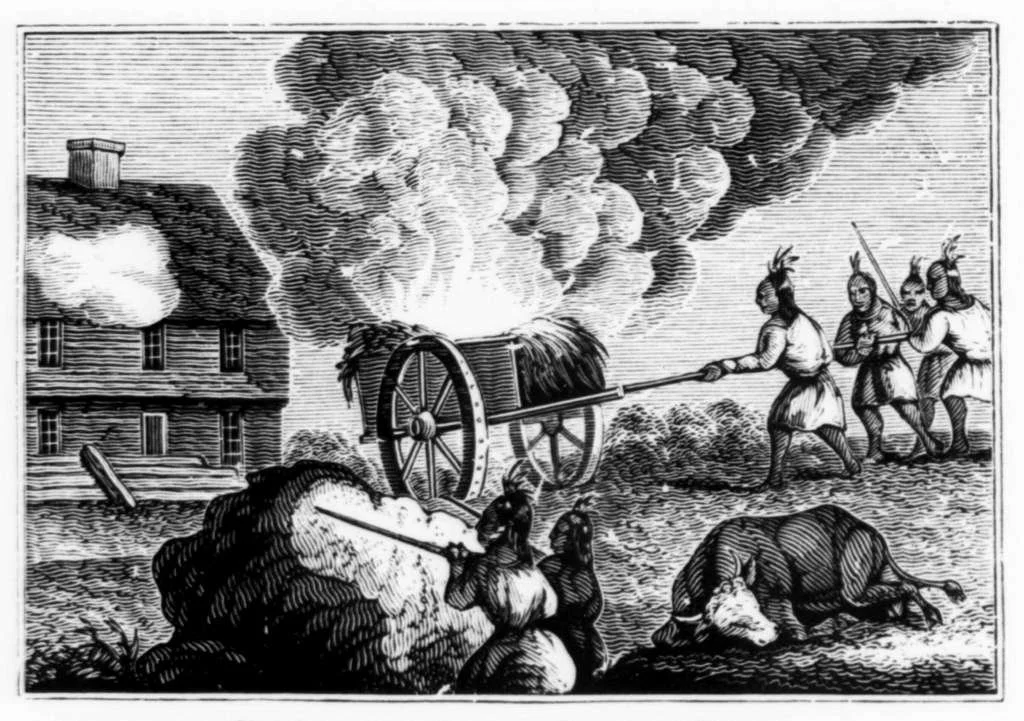
Classic war tactic used by natives during King Philip’s War.
About seven years after Jonathan Senior’s death, the King Philip’s War broke out in New England. The war erupted when some of the Indigenous People revolted against the settlers. This is where we learn more about Jonathan Jr. He was a soldier in that war from the beginning of the actual fighting at Mt. Hope. From records of the early battles, it is evident that he had a horse at that time. His participation in that war was greater than any other of the Fairbanks sons and can be researched in Soldiers in King Philip’s War by George M. Bodge. Using the search function for Fairbanks will take you to Jonathan Jr’s participation.
In conjunction with this research, you may consider Jonathan Jr.’s petition to the Governor and Council in Boston on April 19, 1776. He asks to be granted custody of a young Native girl of 10-12 years old who Jonathan Jr. rescued as part of his military service. Other Natives that had been rescued had been sent to Deer Island, a severe, isolated island for retention of captured Natives. Jonathan Jr.’s motives for this request are not apparent. He may have wanted to save the girl from the fate of Deer Island, or he might have wanted her as a servant as many Natives became servants or were sent to the Caribbean Islands. The request can be found in the Lorenzo Sayles Fairbanks book.
Jonathan and many of his descendants lived in Dedham their whole lives. Jonathan Jr. and Deborah had thirteen children. There could be some discrepancies in this number. Deborah, the wife, died in 1705, and Jonathan Jr. died in 1711/12 about six years later.
Fairbanks Revolutionary War Patriot Project
Lieutenant Samuel Fairbank
Continental Army
Quartermaster
Lineage:
Jonathan I, George II, Jonathan III, Samuel IV, Samuel V
Lieutenant Samuel Fairbank is #225 on page 258 of Lorenzo Sayles Fairbanks’s book, Fairbanks Family in America 1633-1697. He was the sixth generation in his lineage. Samuel was born in Framingham, MA.
Samuel is listed twice under the Continental Army on pages 858-859 with information, but it was found that both were the same Samuel Fairbank.
This Samuel Fairbank could not be found in the National Society Daughters of the American Revolution records. However, he was found as a Quartermaster Sergeant, 8th Co., Lieut. Col. Thomas Nixon’s (4th) regiment for the Continental Army in the Massachusetts Soldiers and Sailors, Volume 5, pp. 468-469. This was followed by extensive services until December 31, 1780.
A Quartermaster was responsible for arranging transportation by wagon or boat, the layout of camps and tents, lumber for huts during the winter encampments, food for the horses, getting equipment, tools, etc. Essentially, he was responsible for procuring anything the army needed at his location. The Quartermaster was sometimes considered the most difficult job in the army as these things were not always easy to procure.
According to the Massachusetts Soldiers and Sailors, Samuel Fairbanks was recognized earlier than November 1776.
On January 1, 1777, to December 31, 1779, he was with the Continental Army, at first as an Ensign, then as a Lieutenant. That alone would have satisfied the three-year commitment that was required for the Continental Army. Immediately, at the end of the first three years, Samuel reenlisted again for one year from January 1, 1780, to December 31, 1780 as a Lieutenant.
Samuel’s descendants provide further information in the Lorenzo Sayles Fairbanks book. Fairbanks Family in America 1633-1697 on pages 258-259. They relate that Lieutenant Samuel Fairbanks was commissioned as a Lieutenant by Samuel Huntington, Esq., President of the Continental Congress at Philadelphia on September 20, 1779. When Samuel decided to resign the second stint of his duties from the Sixth Massachusetts regiment, Samuel was required to ask permission from General George Washington at the Head Quarters in New Windor, New York. According to the family, the date given for this discharge was April 20, 1781.
Samuel married Mary Rodgers. They had 4 children. After the war, Samuel and his family resided in Belle River, Canada.
Summary
It was not easy to relocate and be accepted in a new land and location in the 1600s. Almost every generation had to toil or fight to maintain the new established home of the original family and their descendants.