
Glimpse into Made to Last Forever: The Fairbanks Love Story, Elias Fairbanks, Patriot, and George Fairbanks, Second Son
A Glimpse into Made to Last Forever
The Fairbanks Love Story
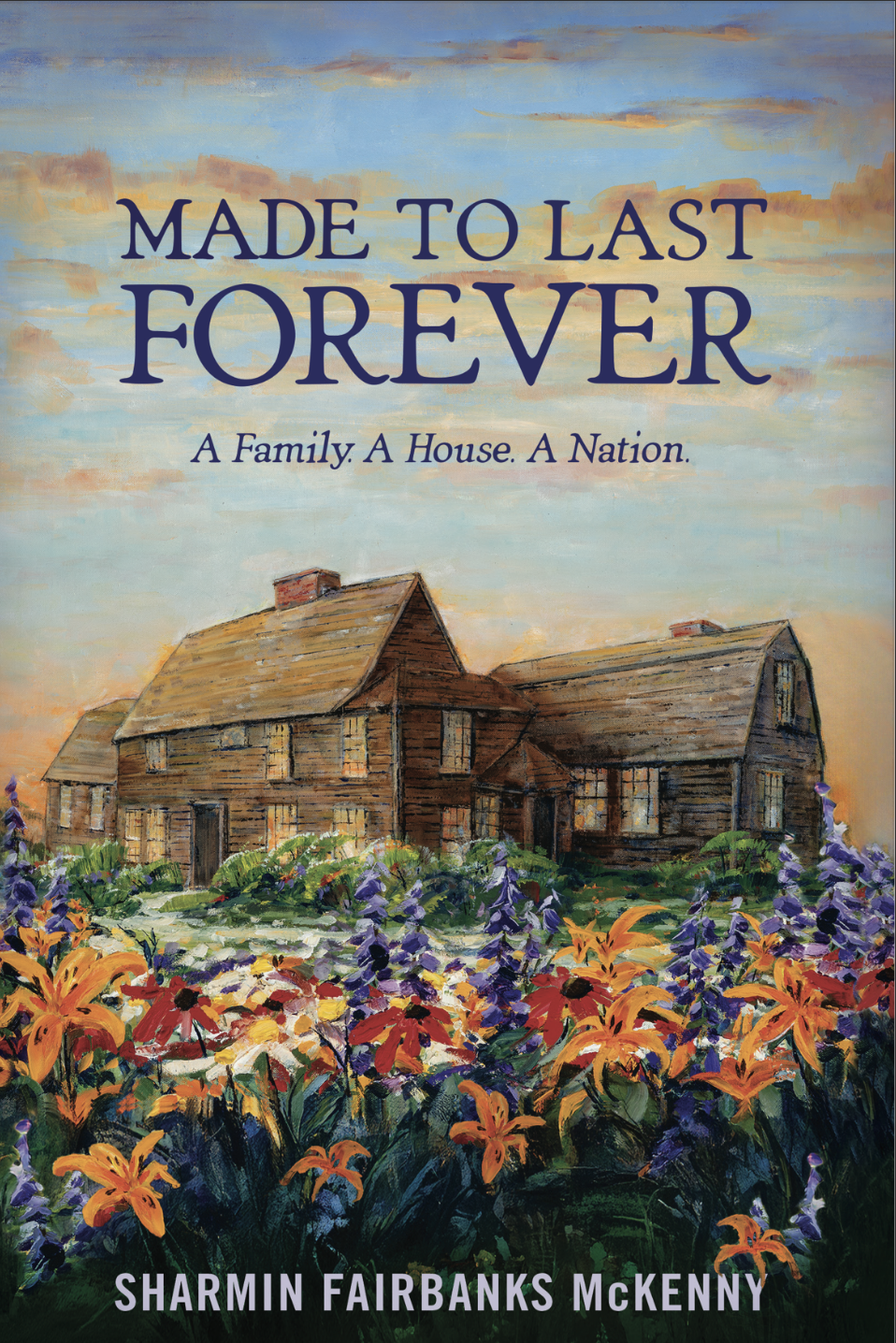
There are many marriages recognized in Made to Last Forever, but only one love story. That love story is found in Part V. It is based on historic events such as the building and usage of the meetinghouse in Lancaster, Massachusetts, the difficulty arranging for the actual individual who officiated the wedding, the date of the wedding and individuals possibly involved during the courtship.
However, the story is embellished by a poem from the 1600s. It is an acrostic poem. It has a secret message that can only be found by following instructions that are given along with the poem. These were popular types of poems in England and the colonies in the colonial period. The old 1600s poem was found in an article "Autograph Albums in the Ozarks" by Vance Randolph and May Kennedy McCord, which appeared in a 1948 issue of The Journal of American Folklore.
Bundling was a part of courting in the colonial period. Bundling was when a young man and lady were allowed to lie together with their clothes on in a chaperoned situation during courting.
The other courting stories were drawn from actual events that happened in later generations of the family line.
In the 1600s, young men were usually in their mid-twenties when they married. They didn’t reach their majority, become a man, until age 21. The young men were expected to have a house and means to provide for a wife and children before they married. Fewer restrictions were placed on a woman’s age, but often they were in their 20s and expected to marry. They were to be skilled at all tasks of a wife: housekeeping, cooking, gardening, spinning and sewing, dairy management and rearing children.
When a father had many daughters, he often encouraged the older daughters to be married before a younger daughter was allowed to be courted. This was to assure the older daughters didn’t become spinsters, unmarried women. The word spinster means someone who spins threads or yarns. Often unmarried women occupied and supported themselves by spinning, so the name for an unmarried woman in the 17th century became spinster.
Puritans did marry for love, but often the girl’s family looked for a suitable match for their daughters that would enhance her and/or her family’s status. Friends of the family were encouraged. If a woman was widowed or a man became a widower, marriage became a necessity to provide for the many children in the disrupted family.
In mid-1600s, John Prescott had five daughters. He founded a village, Lancaster, a long distance from the coastal towns. He had difficulty encouraging people to settle in the isolated village initially. In recruiting single men, as well as families to his village, he hoped that the single men would be suitable for his daughters to marry.
After two of John’s five daughters were married, he recruited a potential minister for his town, Joseph Rowlandson. Having a minister in the town was crucial to the Massachusetts Bay Colony’s approval of town status. A minister was the most desirable match for a daughter. He was considered the most important man in the town; thus, his wife’s status was also elevated. The minister didn’t marry a Prescott daughter.
By the time Made to Last Forever’s love story occurred, there were still three Prescott daughters to be married. By the end of the book all three were married or spoken for. Not always in the order of oldest to youngest. One of the Fairbanks boys married a Prescott daughter even though she had older sisters.
Love is a major and important emotion in life. Courting might have changed over time, but the emotions have not.
Fairbanks Revolutionary War Patriot Project
Elias Fairbanks
Lineage
Jonathan I, John II, Joseph III, Joseph IV, Israel V,
Elias Fairbanks
Elias Fairbanks is found as #109 on page 153 of The Fairbanks Family of America, 1633-1897 by Lorenzo Sayles Fairbanks. He is also found on page 862 and 863 under Miscellaneous Militia. Elias Fairbanks was born in Dedham, Massachusetts Bay Colony, August 7, 1670. He enlisted in the 3rd Suffolk County Regiment of the Massachusetts Militia as a private at age 17. He joined that Regiment of Captain Aaron Smith and Colonel Benjamin Gills on August 15, 1777, three days after Colonel Gill’s regiment was called to reinforce the Continental Army during the Saratoga New York Campaign.
I found no documentation for Elias Fairbanks in the National Society Daughters of the American Revolution website. That probably means no one has used Elias as their Patriot to qualify for membership in that organization.
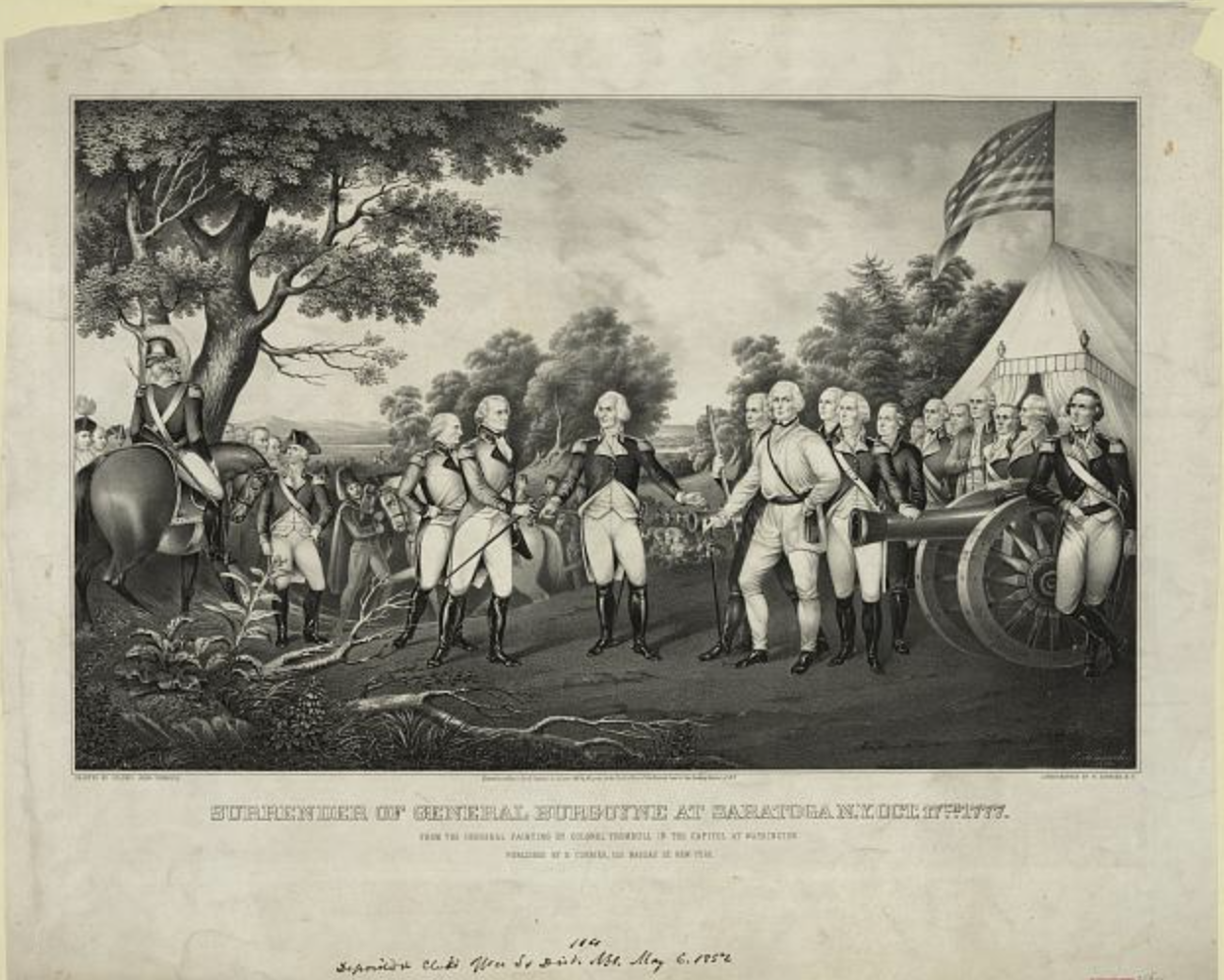
General Bugoyne surrendering at Saratoga. Library of Congress image.
Elias experienced the Battle of Saratoga and attended the surrender of the British under General Burgoyne. Elias remained with the regiment until the Patriot soldiers were discharged. He was discharged November 29, 1777. His enlistment lasted 3 months and 27 days.
The Battle of Saratoga, NY, a Continental Army initiative, was fortified by multiple militias which eventually resulted in the Patriots outnumbering the British. The Patriot victory was a pivotal event in the Revolutionary War. The French were already supplying the Patriots with ammunitions and guns, but after this victory, the French made an alliance with the Patriots and entered the war. As the war drew on the French have been credited with a major role in the overall Patriot victory over the British which would end at Yorktown, New York.
Sometime after the war, Elias moved to Francestown, N. H. where he had dwelt for a time earlier with his uncle Zachariah Whiting. In 1786, Elias married Elizabeth Billings of Canton, Mass. Together they had six children. Elizabeth died in 1816, and Elias died in 1818 at 58 years old.
George Fairbanks, Second Child and Second Son (1619-1684)
George Fairbanks was born the second child and second son to Jonathan and Grace Fairbanks. He was christened in 1619. Like three other children in the family, he was christened at the St. John the Baptist Church in Halifax Parish. The family lived in Shelf, West Yorkshire, New England at that time. Shelf is about 7 miles northeast of Sowerby where the family lived much of the time. Fairbanks, Ruth J. and James Swan Landberg. “Jonathan Fairbank of Dedham, Massachusetts, and his Family in the West Riding of Yorkshire,” The New England Historical and Genealogical Register 166 (July 2012): 165-87.
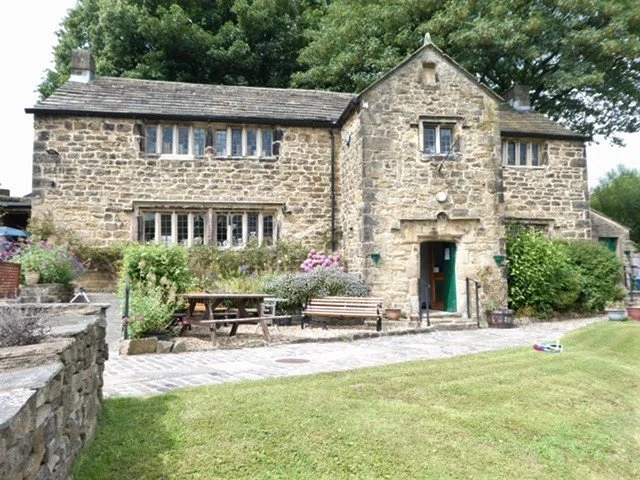
Earby School in Earby, Northern England
By 1627, when George was eight years old, the Fairbanks family was likely in Thornton-in-Craven area because Susan, his sister is believed to be christened at the St. Mary the Virgin Church there. (Robert Abel, Earby and District Local Historical Society communications). Possibly he attended the 1600s Earby school considered to be a very good school, because it taught Latin. The building stands today and is used for other functions. It is a two-story stone building. The schoolmaster’s quarters were upstairs, and the large classroom was downstairs. It is said in historical books that the Fairbanks boys had a good education.
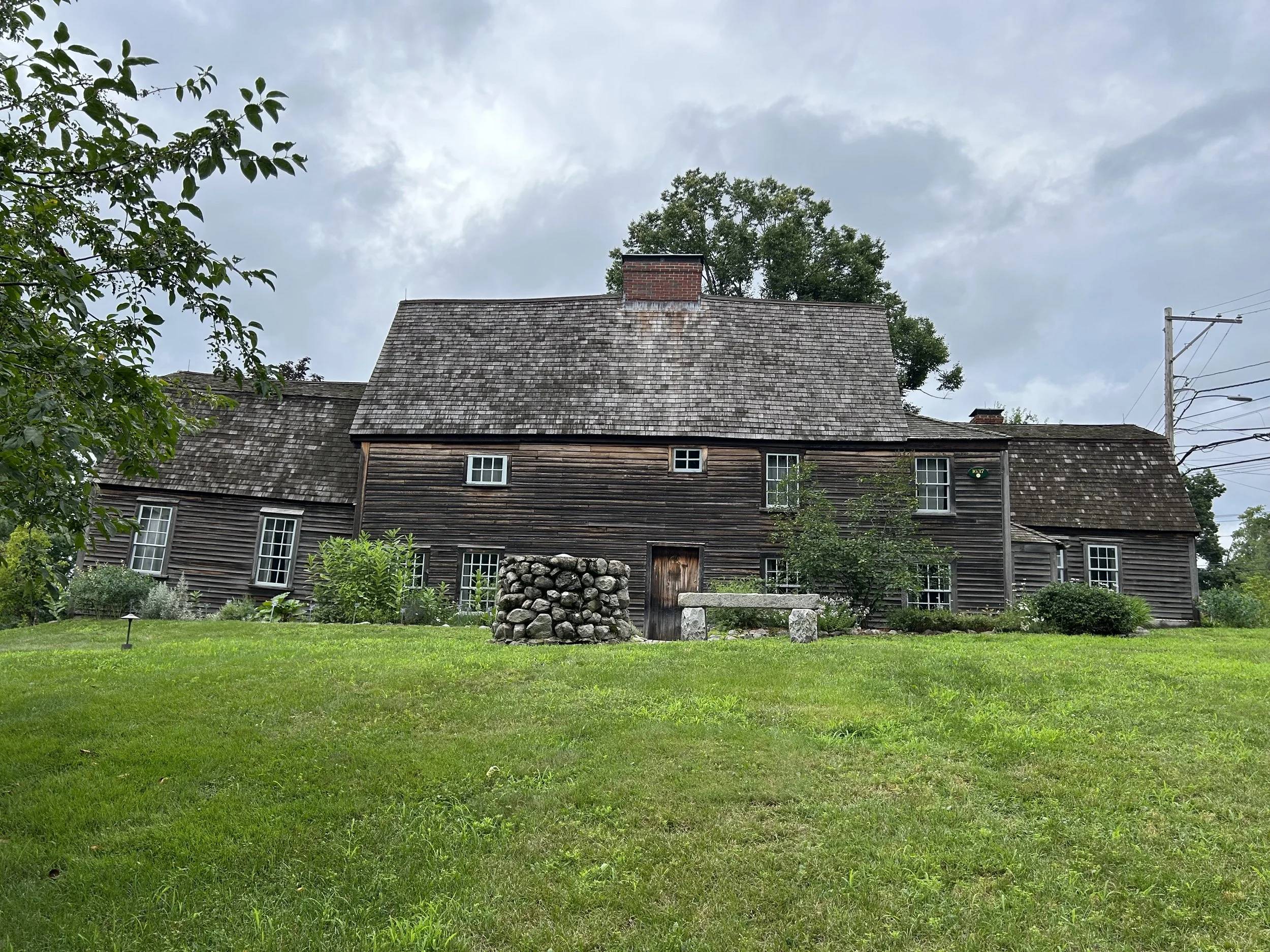
George would have been between 14 and 16 years old when the family sailed to Massachusetts Bay Colony. In 1637, he would have been able to help clear and prepare the new granted land in Dedham for gardens and the Fairbanks house.
George reached his majority, 21 years old, in late 1640. At that time, he could be considered for proprietorship in Dedham. However, there was no documentation in the Dedham Town Records regarding his acceptance as proprietor or receiving a land grant that accompanied it.
George joined the Massachusetts Military Company in 1644. This was a prestigious unit consisting of men from all over the Massachusetts Bay Colony. The company participated in monthly trainings held around Boston. The organization wore green uniforms with red trim. George joined with four other Dedham men at that time. At least three other Dedham men had joined earlier and more joined later. They trained with extensive military equipment including the newest equipment available. This organization later became known as the Ancient and Honorable Artillery Company and was associated with the organization of the same name in England. The organization is active today in ceremonial activities and has a museum at Faneuil Hall in Boston. Of course, all men from 16 through 60 would take part in the Dedham militia and trained in Dedham also.
Two years later, in 1646, George married Mary Adams. He had a house valued at 4 pounds in 1648. This was valued the same as John, his brother’s, and can be compared to their father’s house which was valued at 28 pounds, 23 shillings. (DTR, Vol III page 154) That same year George was granted “one small parcel of land” that abutted his own yard on which to set a barn. At that time, George was referred to by the honorific of Sergeant (DTR, Vol III, p. 124 & 152)
Also in 1648, George was allowed to fell trees in the town common lands, areas belonging to the town and not to an individual. If George put his mark or brand on the trees he fell, they could be left lying for a year. There was a stipulation that the wood was only to be used for making into vessels which he would trade or sell. (DTR Vol III, P. 124) These could have been turned vessels such as bowls, platters, spoon handles, wheels, pails, and stools made with a lathe, or it is possible George made barrels. One man in every town made barrels which would require more trees than household items. Barrels were an important commodity at that time for both liquid and dry storage and transportation.
By 1651, George’s house value had not increased much, it remained at 4 pounds, 6 shillings. John’s house was valued at 4 pounds, 8 shillings. Jonathan’s house had decreased in value to 20 pounds, 17 shillings. (DTR III, p. 183)
It is quite possible that James Fales came to Dedham around this time. It is believed he was apprenticed by George. In a later Dedham Town Records entry, 1662, George is called Jame’s master. (DTR IV, p. 57) James Fales became a proprietor in Dedham in 1654, at the same time Jonathan Jr. did. This was only three years after his arrival, which would indicate he was an apprentice and not a indentured servant because the time time spent with George was shorter than the average indentured servant. (DTR III, p. 139 )
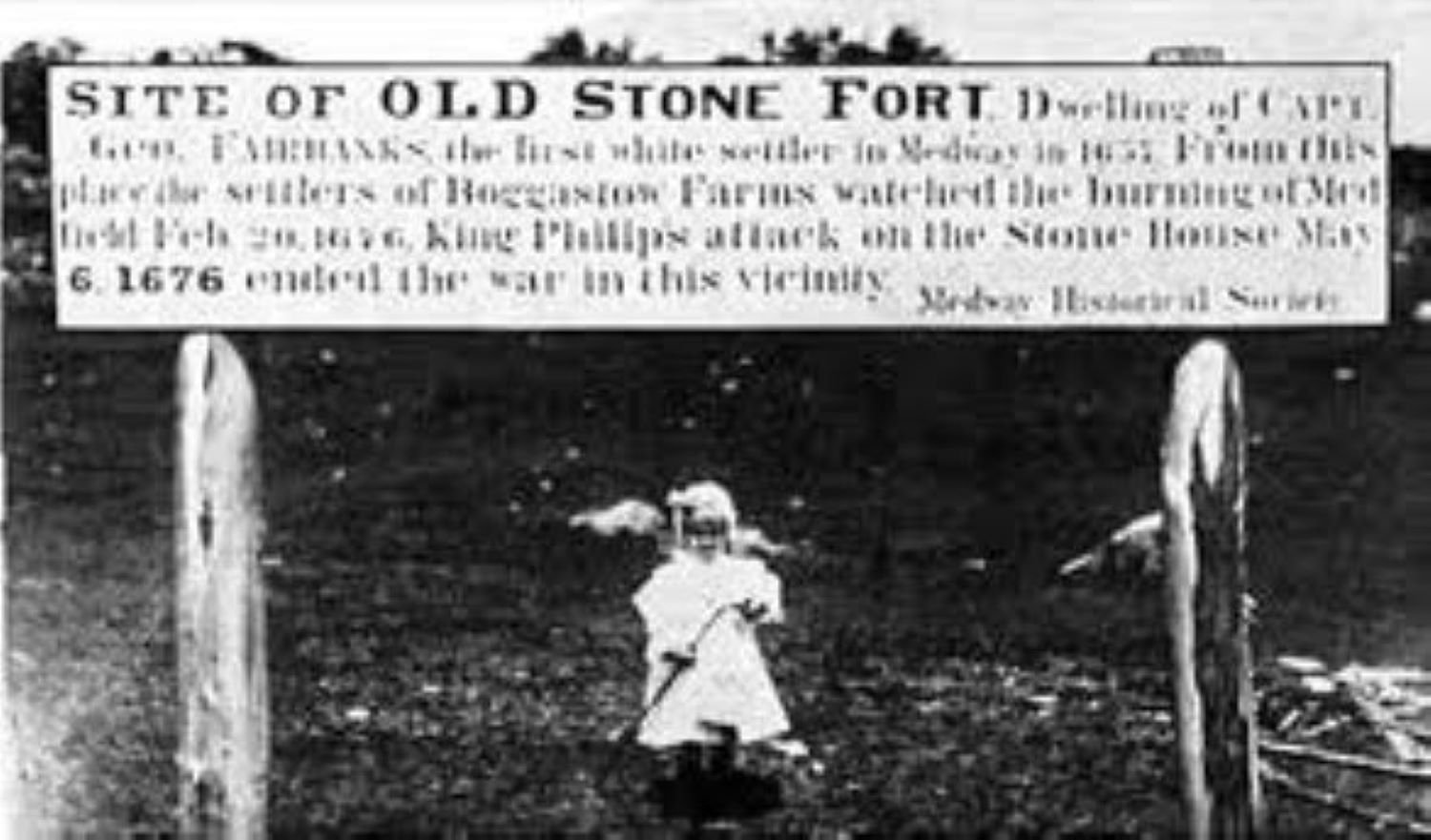
Sign depicting location of the George Fairbanks House. The sign no longer exists.
George and Mary started their family in late 1647. The last child to be born in Dedham was in 1656. They moved their family to the west side of the Charles River in 1657/58. Their house was the first in Medfield west of the Charles River. Their land included some purchased from the minister of Dedham, John Allen, who was granted the land earlier. George and Mary’s house was built near the Boggastow Lake and was a garrisoned or fortified home due to its vulnerability. It’s position, west of the Charles River, separated them from Medfield east of the river.
Two years later, in 1659, Benjamin and Martha (Pidge) Bullard built a house next door to George and Mary. Martha was a four-year-old girl that was placed in the home of Jonathan and Grace Fairbanks about 1644. George probably didn’t lived in the family home at the time. Martha remained with Jonathan and Grace until she was 17 years old and married Benjamin Bullard.
George and Mary had two more children in Medfield in 1662 and 1664.
Jonathan, George’s father, died in 1668. In his will Jonathan requested that George receive 16 pounds after his death. Jonathan delineated that he had already given all his portion of the Medfield grant land, a shop, some work tools and small things to George which should together value 8 pounds. This would be George’s first payment of the 16 pounds. A similar amount as given to Mary, Jonathan’s daughter, Jonas and Jonathan Junior. (Family Search, Film #00703071)
January 10, 1681/82, George died of drowning in the Charles River while repairing bridge supports according to Deloris Hurst.
Summary
Love gives us a sense of belonging as well as other emotions. We all need a sense of belonging. I hope that is one of the emotions Made To Last Forever: A Family. A House. A Nation. will inspire in many of its readers. George’s descendants are among the larger groups that attend the National Fairbanks Reunion annually which represents a feeling of connection with the House and the original family. Elias Fairbanks felt a belonging to and shared purpose with the other Patriots, including the Fairbanks Patriots who fought for the independence of this country. Caring for others and helping a collective cause was a strong motivator in the Revolutionary War. We are the beneficiaries of the drive of those who settle here and secured our independence 250 years ago.