Glimpse into Made to Last Forever: Martha Pidge, Like a Daughter to the Fairbanks Fmily. Revolutionary War Patriot Project, Fairbanks Church.
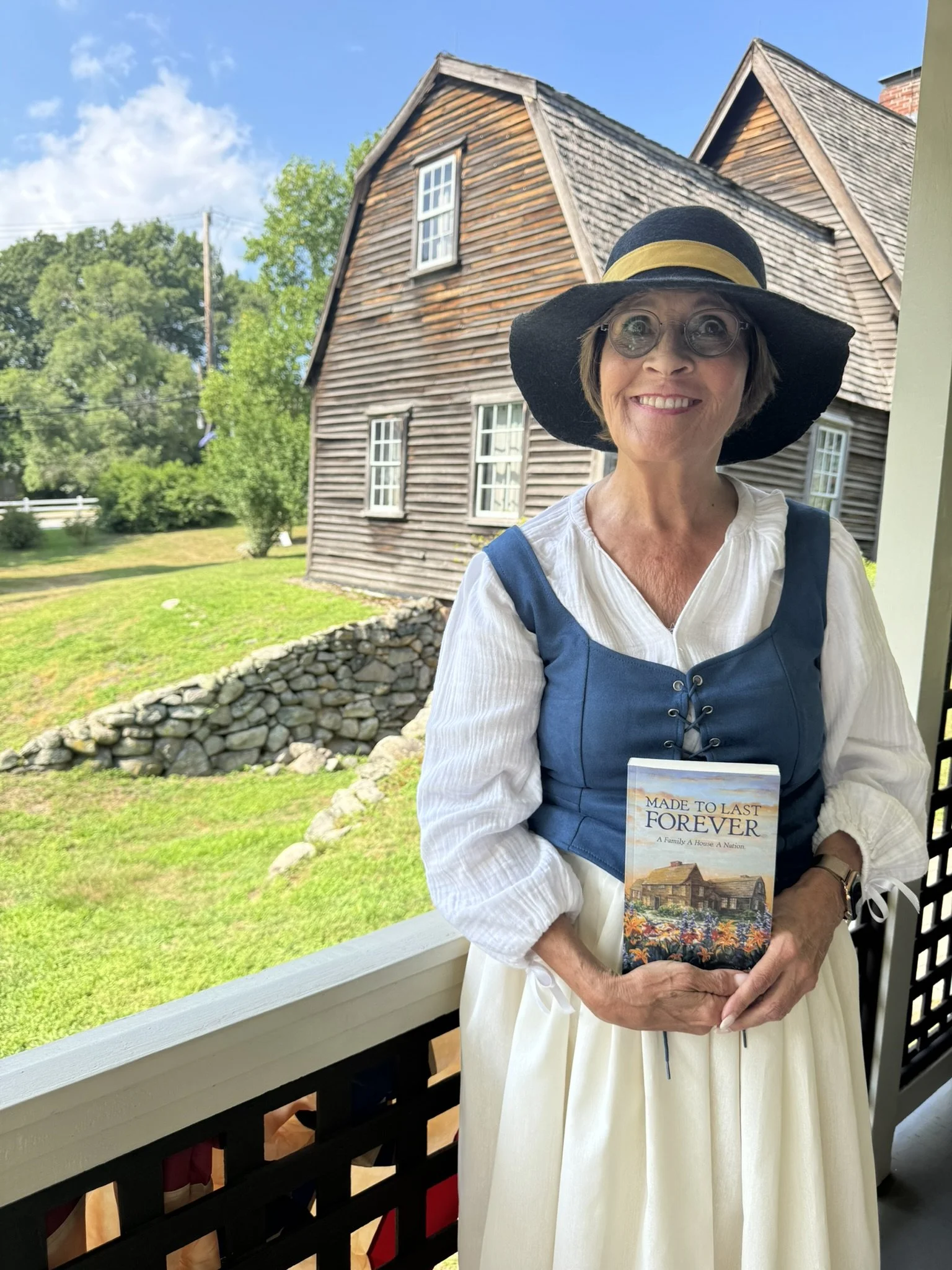
Glimpse into Made to Last Forever: A Family. A House. A Nation.
Martha Pidge
Like a Daughter to the Fairbanks Family
Martha Pidge was a young girl that spent most of her early life as part of Jonathan and Grace’s household.
In England, there were often orphans or children of families who could not provide for them. If the community found the parents could not manage their children, the community could take the children away and place them where the child would learn to work and live responsibly. That lingered in 1600s Dedham to the extent that unruly children could be taken away from parents and placed in a more suitable environment
The conditions in the 1600’s were difficult. Twenty-five percent of the English population were rural poor. It was mandated that the parishes provide for these destitute individuals, which included those “overcharged with children” through taxes or other means. Vexed and Troubled Englishmen 1590-1642 by Carl Bridenbaugh, p. 382. Frequently relatives or other families in a parish took these young children into their homes. They would remain with the family until they reached majority (maturity). For a young man, that was eighteen and a woman twenty-one year
The family accepting the child was responsible for the civil and religious education of the child, much like their own offspring. All children, as young as four years old, were given chores to help the family. As they grew, they took on greater responsibilities. All the while, they learned skills needed for living by doing normal daily activities.
Martha Pidge
A friend of the Fairbanks family, Michael Metcalf Sr. lost his wife, Sarah, in November of 1644. At her death he had nine living children. Subsequently, Michael married the widow, Mary Pidge from Roxbury, in August of 1645. The two families together included nineteen children. The youngest was Martha Pidge born in January 1641/42.
Mary Pidge attempted to place Martha with one of her two uncles who lived in Connecticut and Virginia. The uncles were unable to accommodate the young girl.
The Fairbanks were asked or offered to take Martha into their home around December 1645. Michael Metcalf, Jr. and Mary Fairbanks, Jonathan and Grace’s first daughter and third child, were married April 1644 and were expecting their first child in February 1644/45. Jonathan and Grace’s children were nearly grown. The older three children were married. Jonas was nineteen, Susan, seventeen, and Jonathan Jr. about fifteen. Jonathan and Grace accepted Martha into their home. Grace may have welcomed a young child to help with household chores. Susan would marry three years later.
It is not known if Jonathan and Grace adopted Martha or if she just became an important member of the family. There are no known adoption papers. At age seventee years of age, Martha married a friend of the family, Benjamin Bullard, in 1659. They lived next door to George Fairbanks, the second son of the Fairbanks family, and his family in Medfield.
Even though she is not mentioned in Jonathan Fairbanks’s will of 1668, she is frequently called Martha Fairbanks Bullard on websites of Bullard lineage and in the Bullard Newsletter. In one genealogy, The Genealogy of Several Ancient Puritans by Reverend Abner Morse which includes the Bullard family, Martha is called George Fairbanks’s sister (Morse, page 11).
These, of course can be errors in genealogical documentation, but Martha was referred to enough that it leads this author to believe that Martha was recognized as an integral part of the Fairbanks family.
Lydia Prescott, the youngest daughter of the Prescott family, was born only three and a half years before Martha. This age difference is significant when Jonas falls in love Lydia. There was over 17 years difference in Jonas and Lydia’s ages.
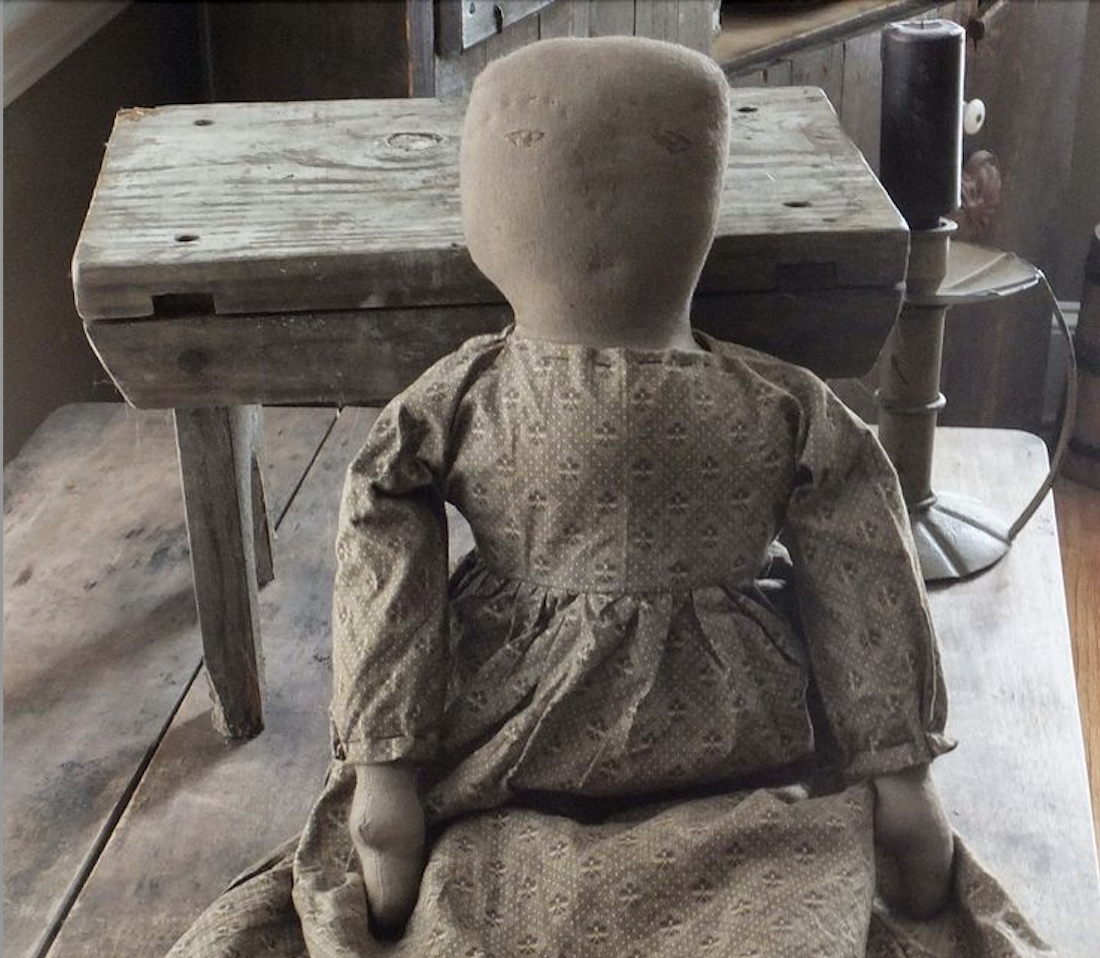
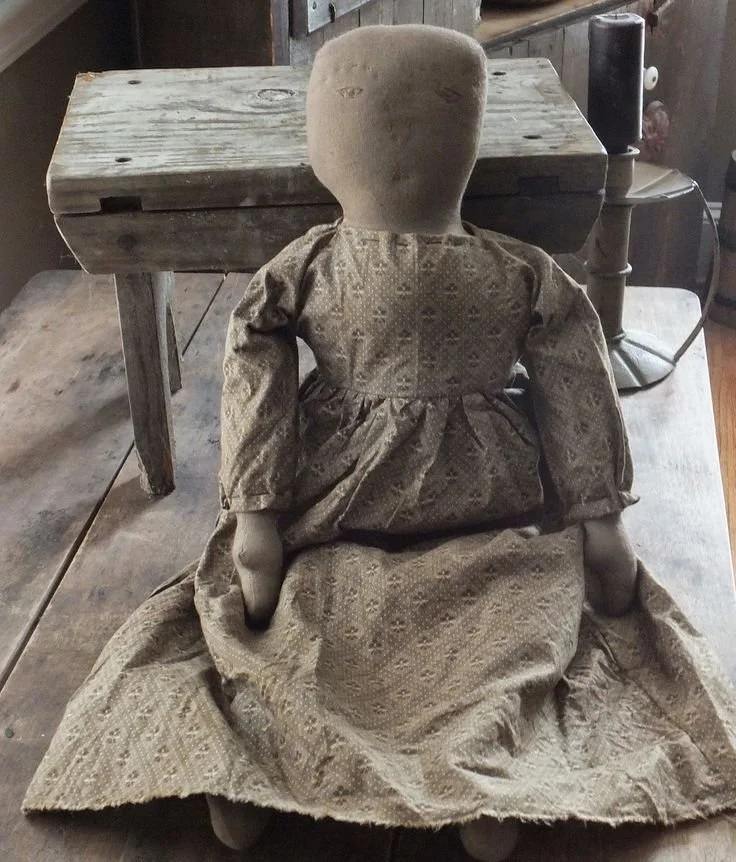
When Martha came to join the Fairbanks family, she may have carried a poppet, an early cloth doll similar to the image in this blog. With many sisters in her family, the doll was probably a hand-me-down. Dolls were often fashioned from common articles like cloth, straw, corn husks, carved of wood, or made of yarn.
Clothes for young children were also often hand-me-downs. After the child, boy or girl, was old enough to wear more than a shift, they were dressed as adults. Often their clothes were fashioned from hand-me-downs from older siblings, or the cloth of previously worn clothes was reused to make new outfits for them. Clothing was fashioned to fit the child and to expand as the child grew with pleats and tucks that could be let out.
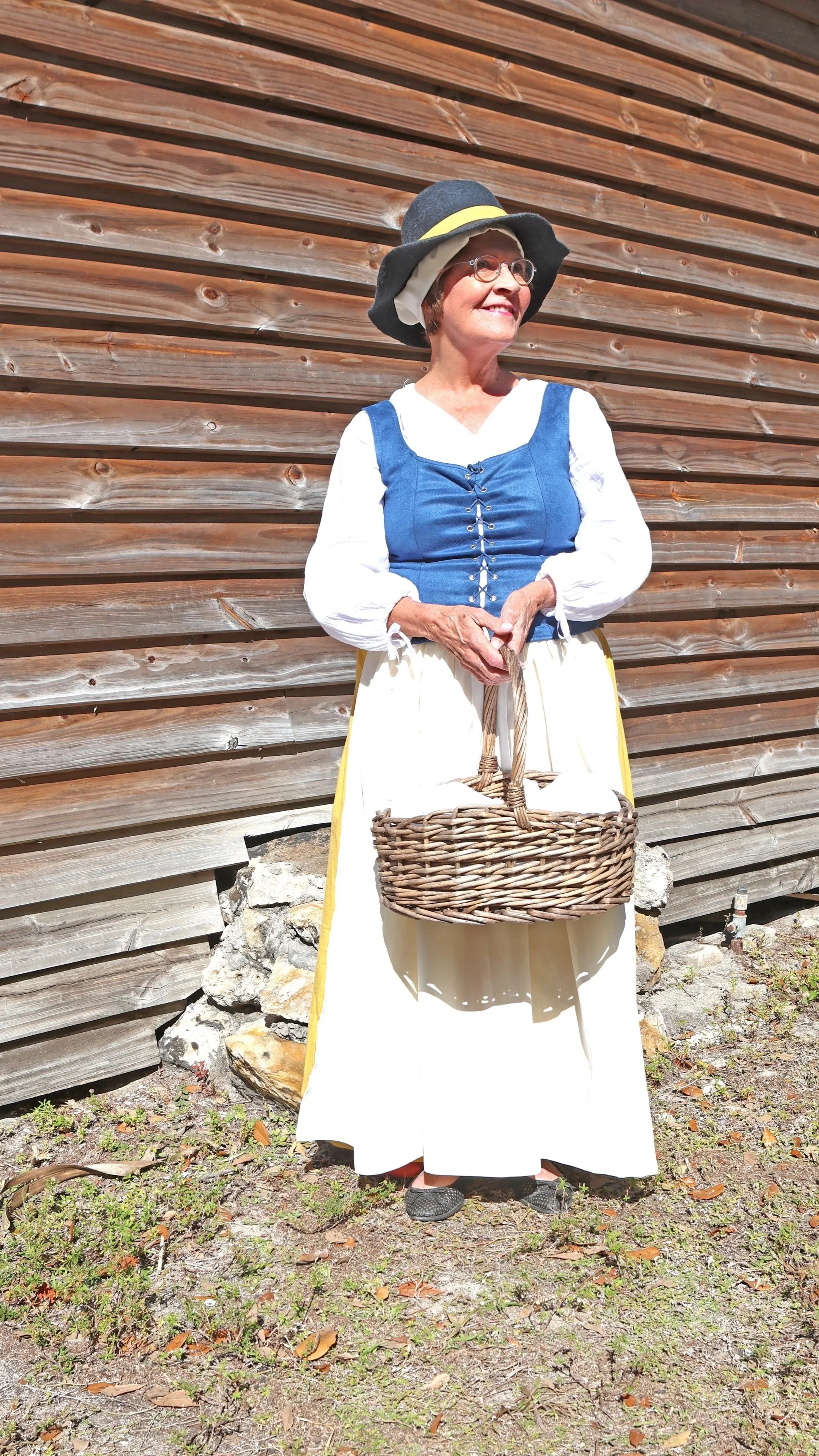
Costume of a 1600s woman
Clothes were expensive. A person may only have one set of outerwear (not coats). Notice, even adult clothes were adjustable. Women became pregnant about ever two years. They needed a way to resize their clothes. Notice the bodices with laces, so they could expand and contract.
The long shift or loose garment was worn by both men and women during the day and night. This garment also served as a blouse or shirt. For women an adjustable skirt and apron were tied over the shift.
With Jonathan and Grace welcoming Martha into their home, they set a precedence for all the many children that have been welcomed into Fairbanks descendants homes over the generations.
Fairbanks Revolutionary War Patriots
Fairbanks Church
Lineage
Jonathan I, Jonathan Jr. II, Samuel III, Abigail Fairbanks IV, Fairbanks Church V
Samuel Fairbanks, third down line, is designated as #14 in the Lorenzo Sayles Fairbanks book, The Fairbanks Family in America: 1633-1897 on page 53-54. His daughter, Abigail, who married Jonathan Church, and their children are listed on page 54. Reference to Fairbanks Church was not found in the National Society of the Daughters of the Revolution data base.
Fairbanks Church was brought to our attention by one of his descendants,Sandy Graner. This is one way we can identify Fairbanks patriots that didn’t carry the Fairbanks surname. At least part of the information was gleaned from Fairbanks Church’s pension record.
Jonathan was born in New London, Connecticut on October 1, 1752. He was twenty-three years old when he first enlisted on July 12, 1775, in Captain Nathan Hale's Company under Colonel Webb’s Connecticut Regiment. Fairbanks trained in New London until the company marched toward Boston and encamped at Roxbury. Church served in this capacity for five months before he was honorably discharged. Later, Nathan Hale, his captain, would become a Revolutionary War spy for the Patriots. Hale was caught and executed, but not before he spoke the words which made him one of the celebrated figures of the Revolutionary War, “I only regret that I have but one life to lose for my country.”
Again on April 1, 1776, Fairbanks Church enlisted a second time as a private. This time in Captain William Latham’s Company under Colonel William Ledyard. He was stationed in Groton, MA, at a fortification later known as Fort Griswold. He helped defend the Connecticut coastline and harbor approaches. Likely, Church served with some of the descendants of Jonas Fairbanks’s line, third son of Jonathan and Grace, who settled the Lancaster, MA area. Some of Jonas’s descendants settled in Groton.
Approximately ten days after completing this second service, F. Church enlisted a third time during the winter of 1776-1777. This three-month enlistment was under Captain Grant and Colonel John Ely. His regiment marched to Providence, Rhode Island, and remained there most of the winter. Fairbanks Church was then honorably discharged in New London, Connecticut.
Fairbanks Church's military record reflects a common man who had a steadfast commitment to the cause of American Independence and was willing to assist whenever the country needed him. Rather than serving a single enlistment, he answered the call to duty on three separate occasions. Fairbanks’s three enlistments spanned three years.
Fairbanks Church married Freelove Latham after he returned from his last service. Fairbanks served with James Comstock who was married to Fairbank Church’s sister, Anna Church. He also served with Joseph Latham, Freelove’s brother. Joseph and Freelove were cousins of Captain William Latham who Fairbanks served under on his second enlistment.
Fairbanks and Freelove had seven children, one son and six daughters. Some of these migrated to the Ohio area. Fairbanks died on June 11, 1836, his wife died 15 years earlier. He is buried in the Old Quaker Hill Cemetery in Quaker Hill, Connecticut.
Sources given by his ancestral descendant:
1. Revolutionary War Pension File of Fairbanks Church, Pension No. S.12470, National
Archives and Records Administration (NARA), Record Group 15, Case Files of Pension and
Bounty-Land Warrant Applications Based on Revolutionary War Service, Publication M804.
2. Declaration of Fairbanks Church, Lyme, Connecticut, August 1, 1832, describing three
periods of Revolutionary War service.
3. Affidavit of James Comstock, June 1, 1832.
4. Affidavit of Joseph Lutharn. (Latham)